Our Tidal Technology
Subhub Tidal Platforms
Proven Track Record of the Community Scale Subhub-CD
QED Naval’s Subhub® tidal platform technology has been developed to provide a practical, scalable and cost-effective route to commercial tidal energy deployment. The company’s strategy is based on offering a family of platform solutions capable of supporting projects ranging from small community-scale developments through to large utility-scale tidal arrays. By standardising key elements of the platform design while maintaining flexibility for different turbine configurations and site conditions, the Subhub concept reduces installation risk, simplifies operations and maintenance, and lowers the overall cost of tidal energy generation.
The most mature embodiment of this technology is the community-scale Subhub-CD platform, which has now accumulated more than six years of operational experience across three separate projects. Development began under a Scottish Enterprise SMART R&D programme, through which QED Naval and its shareholders designed and constructed a full-scale demonstrator in Belfast’s Titanic Quarter. Following assembly, the platform was launched from the D1 Quay, a facility previously used by Dong Energy (now Ørsted) to support offshore wind farm deployments. The platform was subsequently deployed to Strangford Lough, where it successfully demonstrated its innovative submerged ballast system, enabling installation and recovery operations to become a largely push-button process. During its two-year deployment, the platform validated key operational procedures while demonstrating the benefits of a foundation system that requires minimal seabed intervention and can be removed without leaving permanent infrastructure behind. At the end of the programme, the Subhub-CD was fully decommissioned within a week, leaving the seabed clear and the site restored to its original condition.
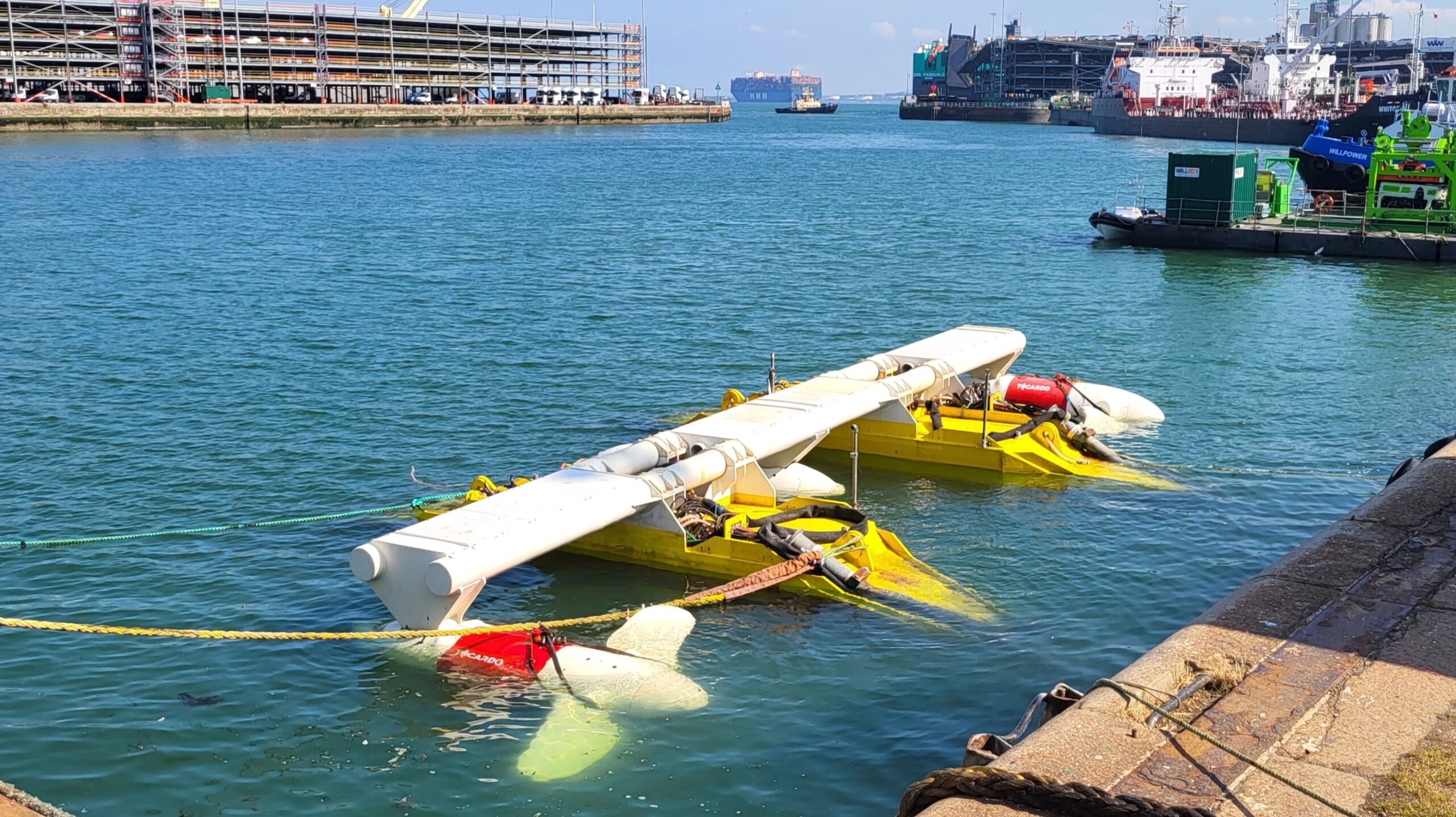
Building on this success, the platform was redeployed under the EU Interreg TIGER project and towed approximately 200 nautical miles to Pembroke Dock, where it underwent a major refit and was integrated with newly acquired Tocardo T1 tidal turbines. A key feature of the programme was QED Naval’s emphasis on system reliability and risk reduction. The complete integrated platform, including turbines, electrical systems and control systems, was fully assembled and tested onshore before deployment, ensuring that all components functioned as intended prior to entering the marine environment. Following commissioning, the Subhub demonstrated remarkable towability and survivability, being transported through challenging sea states including wave heights of around four metres before transiting into the Solent and onward to its deployment location within Langstone Harbour. There, the platform has provided a valuable demonstration of integrated tidal energy generation and operational performance in a real-world environment.
The Subhub platform’s operational history demonstrates one of its greatest advantages: the ability to be installed, recovered, refurbished and redeployed multiple times without the need for expensive offshore lifting vessels or permanent seabed foundations. This significantly reduces project costs, shortens installation schedules and minimises environmental impact. Following a further two years of operation in Langstone Harbour, the platform is scheduled for decommissioning and recovery, once again demonstrating the complete lifecycle capability that QED Naval has engineered into the Subhub concept.
The lessons learned from more than six years of successful operations have directly informed the development of QED Naval’s next-generation Subhub platforms, which are designed to support larger turbines and utility-scale tidal energy projects. By proving the core technologies, installation methods and operational philosophy in real marine environments, the Subhub programme has established a strong foundation for the commercial deployment of tidal energy at scale, providing developers with a robust, low-impact and highly adaptable platform solution capable of unlocking the vast tidal resources around the UK and beyond.
The Next Generation Industrial Scale Subhub-ID
Next-Generation Subhub-ID Industrial Tidal Platform
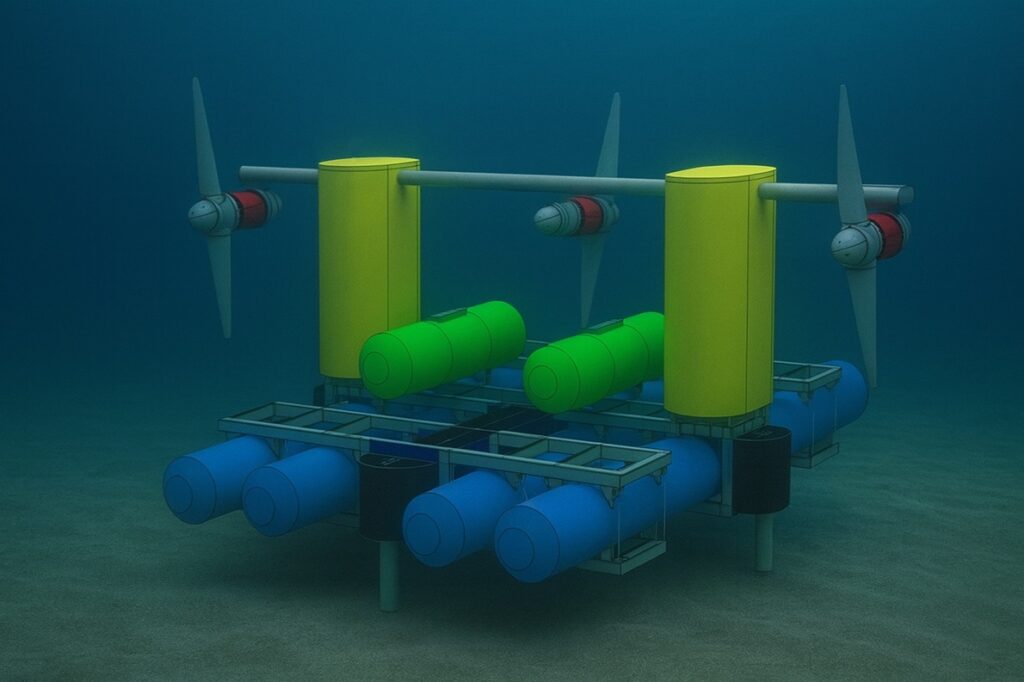
Building on more than a decade of research, development, demonstration and operational experience, QED Naval has developed the Subhub-ID (Industrial Demonstrator) platform as the next evolution of its proven Subhub technology. The Subhub-ID inherits the core operational philosophy that made the Subhub-CD successful, including rapid installation, retrieval, refurbishment and redeployment, while incorporating numerous engineering improvements and lessons learned from real-world deployments in Strangford Lough, Pembroke Dock and Langstone Harbour. The result is a platform specifically designed for commercial-scale tidal energy projects, offering improved manufacturability, reduced installation costs and enhanced operational performance.
A key innovation within the Subhub-ID is its Rapid Assembly Modular Platform (RAMP) construction methodology. Traditional large offshore structures can be constrained by fabrication capacity, transportation logistics and assembly complexity. The RAMP approach addresses these challenges by utilising a modular design based around transverse structural sections that act as both the primary structural framework and the assembly jig for the platform. These sections are then connected using standard steel members, significantly simplifying fabrication, reducing the need for specialist facilities and enabling efficient construction using existing regional supply chains. This innovative build philosophy allows large structures to be manufactured, transported and assembled using conventional infrastructure, creating substantial opportunities for local fabrication yards and engineering companies.
Like its predecessor, the Subhub-ID has been designed around a low-cost deployment philosophy. The platform can be assembled quayside, fitted with turbines and electrical systems, and subjected to comprehensive pre-deployment testing before being towed to site. Once on location, the platform can be installed on the seabed in as little as a single day using the proven submerged-ballast methodology developed and validated through earlier Subhub projects. This approach minimises offshore vessel time, reduces weather risk during installation and significantly lowers overall project costs when compared with conventional marine energy deployment methods.
At the heart of the platform are the Subsea Power Control Units (SPCUs), which contain all critical electrical and power conversion equipment, including transformers, switching gear, protection systems and power electronics. By housing these systems within dedicated subsea modules, the platform centralises power management and enhances operational reliability. The SPCUs provide full monitoring, control and protection capabilities, allowing the entire power plant to be remotely operated and managed from either the Morlais grid connection substation or directly from Mor Energy’s operational offices. This high degree of automation reduces operational costs, limits offshore intervention requirements and provides real-time performance and condition monitoring across the installation.
The initial Subhub-ID deployment has been configured for an installed capacity of approximately 1.5 MW, while the platform architecture has been designed to support future expansion to 2.5 MW without fundamental changes to the underlying infrastructure. This scalability provides a flexible pathway for project growth while reducing future capital expenditure requirements. The platform is expected to achieve an Annual Energy Production (AEP) exceeding 3,000 MWh under the parameters established for the Allocation Round 5 (AR5) Contracts for Difference regime, delivering the energy yields necessary to support commercially viable tidal energy projects.
The strong economic performance of the Subhub-ID is driven not only by its low-cost installation and maintenance strategy, but also by its hydrodynamic design. The platform benefits from flow steering and flow acceleration effects, which optimise the velocity and distribution of tidal currents through the turbine array, increasing energy capture and overall system efficiency. When combined with the proven reliability of Tocardo turbine technology and the platform’s rapid deployment methodology, the Subhub-ID offers a compelling solution for the commercialisation of tidal stream energy. It represents a significant step towards delivering predictable, affordable and scalable renewable energy from the UK’s abundant tidal resources while maximising local supply chain opportunities and long-term economic value.
Tocardo Tidal Turbine
Mor Energy’s tidal energy projects benefit from the proven reliability and efficiency of Tocardo’s turbine technology, which has been refined through almost two decades of research, development, testing and commercial operation. At the heart of the design is a robust direct-drive permanent magnet generator (PMG) system that eliminates the need for complex gearboxes, reducing mechanical losses, maintenance requirements and potential points of failure. Combined with Tocardo’s highly efficient bi-blade rotor design, the turbines are capable of achieving excellent energy capture while maintaining a simple, durable and cost-effective configuration suited to demanding tidal environments.
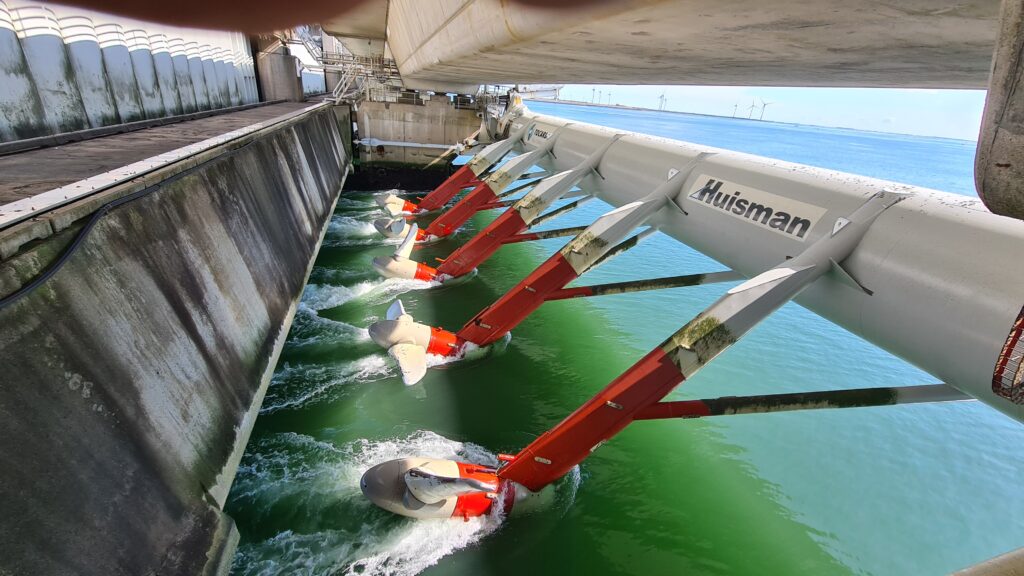
The technology has been successfully demonstrated through multiple deployments, including the Den Oever Project, which utilised the T1 turbine design, and the Oosterschelde Tidal Power Project in the Netherlands, which deployed the larger T2 turbines. The Oosterschelde project is particularly significant as it demonstrated sustained commercial operation with grid-connected generation, accumulating more than 57,000 operating hours and exporting over 3.5 GWh of renewable electricity to the grid. Throughout this extensive operational period, the T2 turbines achieved an exceptional reliability record, with no turbine failures recorded, providing strong evidence of the technology’s robustness and suitability for long-term commercial deployment. This proven performance gives Mor Energy confidence that Tocardo turbines can deliver predictable energy production, high availability and low lifecycle costs, supporting the successful development of reliable tidal energy projects in Welsh waters.
The Next Generation T3-Q Turbine
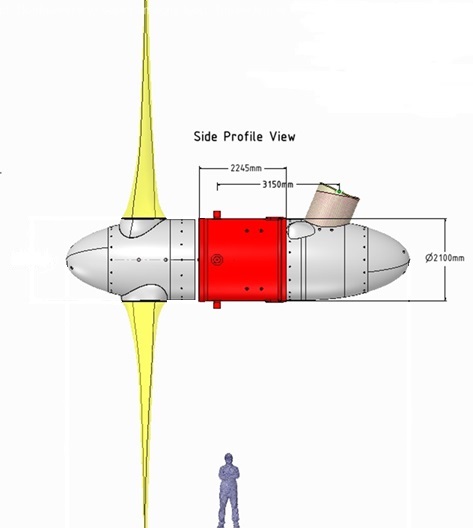
The Tocardo T3-Q represents the next generation of tidal turbine technology which will be used in the early stage arrays at Morlais and Mor Energy’s AR5 and AR7 projects. Building on the proven design philosophy that has underpinned Tocardo’s success for nearly two decades. Central to this approach is the continued use of a highly reliable direct-drive permanent magnet generator (PMG), which eliminates the need for complex drivetrain components and minimises maintenance requirements in the harsh marine environment. Drawing on extensive operational experience from earlier T1 and T2 turbines, Mor Energy and QED Naval engineers have further optimised the turbine topology to improve manufacturability, reliability and cost-effectiveness while maintaining the robust performance characteristics that have been demonstrated through years of commercial operation.
Alongside the T3-Q, the engineering team has developed a geared variant known as the T3-H, which has been specifically optimised to deliver performance comparable to the proven T2 turbine while providing additional flexibility in generator design and supply chain sourcing. Two blade configurations have also been developed for the platform. Initial deployments will utilise a stiff, high-thrust blade design developed by QED Naval, providing a robust and predictable solution for early commercial projects. While this blade delivers strong performance across much of the operating envelope, its top-end energy capture is intentionally limited and turbine braking is required during extreme storm wave conditions. As the technology evolves, these turbines will be upgraded with an advanced flexi-blade high-yield design, which is being developed to increase energy production, improve load management and enhance turbine performance across a wider range of tidal and wave conditions. This phased approach enables Mor Energy to deploy proven technology today while creating a clear pathway towards higher efficiency, lower operating costs and improved long-term project economics.